My Internet history
The early years
This will be my personal history of the Internet. Because some of it is from memory, I will be editing this page extensively.
The photo is of "Deb's Web" from December 1996. The site was actually earlier. The first web pages were gray. Color did not become the fashion until HTML 3.0, at which point you got 16 colors to work with. I taught many internet classes with gray web sites. The first "Introduction to the Internet" class was all line command.
I did line command on a mainframe computer after work hours. Basically, you would enter a line command such as telnet>site.name to visit and see what was available to you. The first internet browser was SlipKnot, which attempted to make a graphical interface to a line text world. SlipKnot was painful to use.
My beginning web pages were sent to our network manager, Ruth Watson. Later, Ruth and I were to teach a couple of classes a semester. She suggested creating "Deb's Web," which stayed around for a while before search engines were available. The whole premise of "Deb's Web" was to list interesting sites to visit, including those featuring music videos and resources about banjo guitar and bass guitar.
There was a lot of funding needed to get everyone onboard the "Information superhighway," as it was called by the media then. Computer labs and classrooms, routers and wiring - lots of pulled wiring - were needed. Ruth Watson, Larry Jones, and many other people at Kent State University worked on securing funding. I focused on having fun with it.
The best way to get funding is to have politicians visit. I am not sure of the date, but at one point, with news cameras running, I was teaching then Governor George Voinovich how to create web pages. I was so terribly shy, and though the video is probably lost, it had to have shown in the recordings taken that day. For me, creating web sites has always been fun.
Ruth Watson and I taught classes right from the beginning of Kent State University's commitment to bringing the Internet to Kent's faculty, students, and staff. Initially as a special topics course, later transitioning to regular courses, we always carried a full complement of students, many of whom went on to work in the IT field. I have always been proud of each one of our students.
It was during this time I earned my second Master's degree. I already had a Master's of Library Science, and this time it was a Master's in Technology. I was working a full-time administrative position, teaching part-time, and working on my Master's Degree. The only free time I had was Sunday afternoons; no one outside of Kent saw me.
The first course was "Introduction to the Internet." This course was taught, at first, as accessing the internet via line commands, as I mentioned earlier. The students learned the history of the Internet up to and including Netscape Navigator. We taught them what gopher, telnet, etc., etc., were and how to use them.
This was also the era of the Youngstown Freenet. The Freenets were community-based areas of the internet where I met many of my friends. But I digress.
Ten years later, Ruth and I went our separate ways. She went into full-time teaching; I transitioned into Distance Education. By this time, we had developed and taught classes in Web Development, Multimedia Development, Web programming, early cell phone programming, XML, Distance Education, just to name a few.
In the mid-1990s, Kent State University assisted a startup company with a product called LearnLinc. LearnLinc was desktop videoconferencing with multimedia course content. (Think of it as kind of classroom Skype.) My interest in Distance Education was spiked. I left the Trumbull Campus to join the staff on the Kent Campus.

A colorful 1990s-style webpage with links on various topics like HTML, amusement parks, and Star Trek.
LearnLinc, VTEL and Polycom
Distance Education
This will be my personal history of the Internet. Because some of it is from memory, I will be editing this page extensively.
The photo is of "Deb's Web" from December 1996. The site was actually earlier. The first web pages were gray. Color did not become the fashion until HTML 3.0, at which point you got 16 colors to work with. I taught many internet classes with gray web sites. The first "Introduction to the Internet" class was all line command.
I did line command on a mainframe computer after work hours. Basically, you would enter a line command such as telnet>site.name to visit and see what was available to you. The first internet browser was SlipKnot, which attempted to make a graphical interface to a line text world. SlipKnot was painful to use.
My beginning web pages were sent to our network manager, Ruth Watson. Later, Ruth and I were to teach a couple of classes a semester. She suggested creating "Deb's Web," which stayed around for a while before search engines were available. The whole premise of "Deb's Web" was to list interesting sites to visit, including those featuring music videos and resources about banjo guitar and bass guitar.
There was a lot of funding needed to get everyone onboard the "Information superhighway," as it was called by the media then. Computer labs and classrooms, routers and wiring - lots of pulled wiring - were needed. Ruth Watson, Larry Jones, and many other people at Kent State University worked on securing funding. I focused on having fun with it.
The best way to get funding is to have politicians visit. I am not sure of the date, but at one point, with news cameras running, I was teaching then Governor George Voinovich how to create web pages. I was so terribly shy, and though the video is probably lost, it had to have shown in the recordings taken that day. For me, creating web sites has always been fun.
Ruth Watson and I taught classes right from the beginning of Kent State University's commitment to bringing the Internet to Kent's faculty, students, and staff. Initially as a special topics course, later transitioning to regular courses, we always carried a full complement of students, many of whom went on to work in the IT field. I have always been proud of each one of our students.
It was during this time I earned my second Master's degree. I already had a Master's of Library Science, and this time it was a Master's in Technology. I was working a full-time administrative position, teaching part-time, and working on my Master's Degree. The only free time I had was Sunday afternoons; no one outside of Kent saw me.
The first course was "Introduction to the Internet." This course was taught, at first, as accessing the internet via line commands, as I mentioned earlier. The students learned the history of the Internet up to and including Netscape Navigator. We taught them what gopher, telnet, etc., etc., were and how to use them.
This was also the era of the Youngstown Freenet. The Freenets were community-based areas of the internet where I met many of my friends. But I digress.
Ten years later, Ruth and I went our separate ways. She went into full-time teaching; I transitioned into Distance Education. By this time, we had developed and taught classes in Web Development, Multimedia Development, Web programming, early cell phone programming, XML, Distance Education, just to name a few.
In the mid-1990s, Kent State University assisted a startup company with a product called LearnLinc. LearnLinc was desktop videoconferencing with multimedia course content. (Think of it as kind of classroom Skype.) My interest in Distance Education was spiked. I left the Trumbull Campus to join the staff on the Kent Campus.
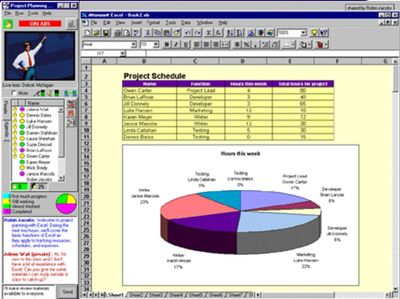
Microsoft Excel project schedule with pie chart and live chat interface.
Winding down
Heading to retirement
This will be my personal history of the Internet. Because some of it is from memory, I will be editing this page extensively.
The photo is of "Deb's Web" from December 1996. The site was actually earlier. The first web pages were gray. Color did not become the fashion until HTML 3.0, at which point you got 16 colors to work with. I taught many internet classes with gray web sites. The first "Introduction to the Internet" class was all line command.
I did line command on a mainframe computer after work hours. Basically, you would enter a line command such as telnet>site.name to visit and see what was available to you. The first internet browser was SlipKnot, which attempted to make a graphical interface to a line text world. SlipKnot was painful to use.
My beginning web pages were sent to our network manager, Ruth Watson. Later, Ruth and I were to teach a couple of classes a semester. She suggested creating "Deb's Web," which stayed around for a while before search engines were available. The whole premise of "Deb's Web" was to list interesting sites to visit, including those featuring music videos and resources about banjo guitar and bass guitar.
There was a lot of funding needed to get everyone onboard the "Information superhighway," as it was called by the media then. Computer labs and classrooms, routers and wiring - lots of pulled wiring - were needed. Ruth Watson, Larry Jones, and many other people at Kent State University worked on securing funding. I focused on having fun with it.
The best way to get funding is to have politicians visit. I am not sure of the date, but at one point, with news cameras running, I was teaching then Governor George Voinovich how to create web pages. I was so terribly shy, and though the video is probably lost, it had to have shown in the recordings taken that day. For me, creating web sites has always been fun.
Ruth Watson and I taught classes right from the beginning of Kent State University's commitment to bringing the Internet to Kent's faculty, students, and staff. Initially as a special topics course, later transitioning to regular courses, we always carried a full complement of students, many of whom went on to work in the IT field. I have always been proud of each one of our students.
It was during this time I earned my second Master's degree. I already had a Master's of Library Science, and this time it was a Master's in Technology. I was working a full-time administrative position, teaching part-time, and working on my Master's Degree. The only free time I had was Sunday afternoons; no one outside of Kent saw me.
The first course was "Introduction to the Internet." This course was taught, at first, as accessing the internet via line commands, as I mentioned earlier. The students learned the history of the Internet up to and including Netscape Navigator. We taught them what gopher, telnet, etc., etc., were and how to use them.
This was also the era of the Youngstown Freenet. The Freenets were community-based areas of the internet where I met many of my friends. But I digress.
Ten years later, Ruth and I went our separate ways. She went into full-time teaching; I transitioned into Distance Education. By this time, we had developed and taught classes in Web Development, Multimedia Development, Web programming, early cell phone programming, XML, Distance Education, just to name a few.
In the mid-1990s, Kent State University assisted a startup company with a product called LearnLinc. LearnLinc was desktop videoconferencing with multimedia course content. (Think of it as kind of classroom Skype.) My interest in Distance Education was spiked. I left the Trumbull Campus to join the staff on the Kent Campus.

Kent State University Ashtabula sign with flags on a sunny day.